


Geamaster+: the advanced dynamic stabilometric platform
GEAMASTER+ Platform is an advanced device for assessing postural sway in both static and dynamic conditions. It provides a quantitative and qualitative evaluation of postural control, helping professionals to plan personalized rehabilitation programs and monitor patient progress.
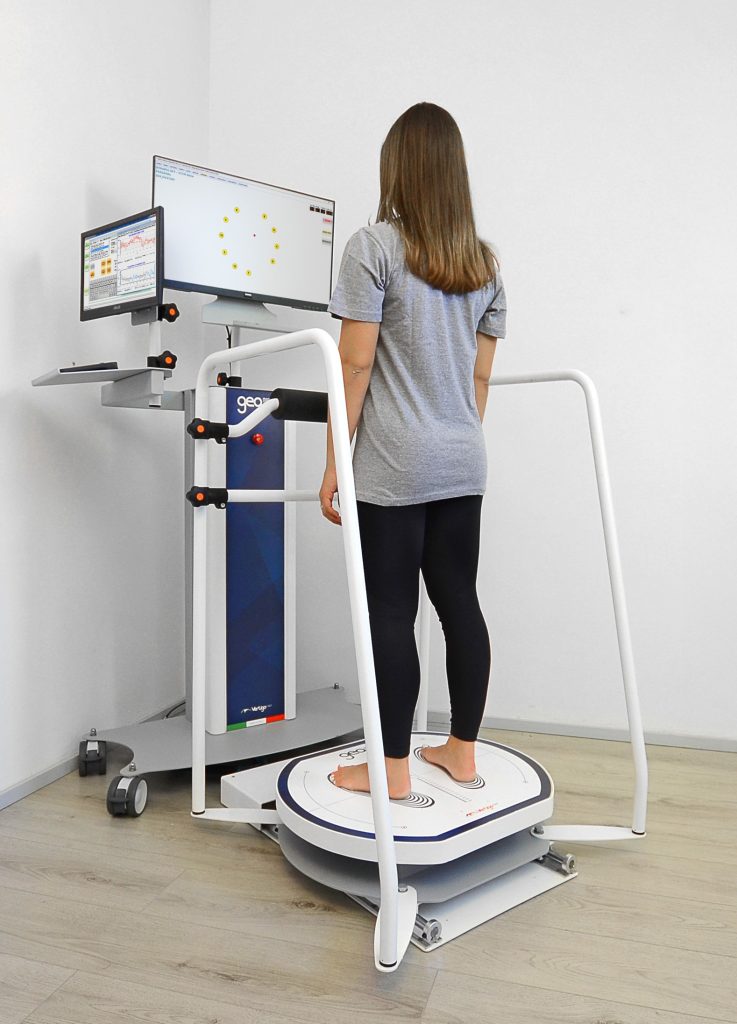
How it works
It combines four operating modes:
- Static mode: analyzes stability in an upright position.
- Dynamic mode without stimulus: measures the Center of Pressure (COP) on an unstable platform.
- Dynamic mode with mechanical stimulus: the platform performs tilting, translation, and vertical displacement movements, activating the neuromotor mechanisms responsible for balance control.
- Dynamic mode with translation: generates sudden stimuli that reproduce real-life situations to assess neuromuscular reactivity.
It features 20 levels of adjustable instability and 10 mechanical perturbation modes, providing a comprehensive and customizable postural training solution for every individual, from the elderly to athletes.
Capability, Challenge
Performance+
- Clinical research
- Multifactorial assessment of somatosensory organization
- Fall risk evaluation
- Balance disorders related to neuromuscular control
- Advanced analysis and rehabilitation of vestibular function
- Advanced prosthetic rehabilitation
- Advanced orthopedic rehabilitation


Advanced Technology
The GEAMASTER+ Platform is equipped with four electro-pneumatic actuators that constantly modulate the instability of the support base, and an independent actuator capable of generating a translational movement of about 3 cm.
Through precise and continuous modulation of instability and perturbation parameters, the operator can personalize the level of difficulty, ensuring a progressive, safe, and comprehensive treatment tailored to each patient’s postural needs.
The system acquires the Center of Pressure (COP) at high resolution (24-bit) and 100 Hz, accurately detecting postural oscillations for processing through internationally standardized algorithms.
Its unique features make GEAMASTER+ a valuable tool for professionals in physical medicine, orthopedics, otolaryngology, neurorehabilitation, and scientific research, providing effective support for postural assessment and treatment.
Enhanced sensorimotor assessment
The GEAMASTER Platform includes software with 50 dedicated tests for stabilometric assessment, offering a comprehensive range of protocols to analyze the patient’s motor and sensory capabilities.
Benefits of visual and auditory biofeedback:
- Improves body awareness.
- Makes training more engaging.
- Promotes sensory reprocessing.
- Activates self-correction

INCLUDED ACCESSORIES
- Soft mat for Balance Testing
- Millimeter-marked foot alignment template
- Lateral and front support system
- Vertical harness-based patient support with adjustable settings
- 34” Ultra-Wide Curved Display
OPTIONAL ACCESSORIES
- Trunk sensor
- Integrated chair for trunk balance training

GEAMASTER+ is an ergonomic aluminium platform equipped with advanced sensors that ensure accurate and consistent measurements.
In addition to standard protocols, it offers dedicated algorithms for dynamic modes, which include various levels of instability, disturbance and translation. This versatility makes it ideal for neurological and vestibular research and rehabilitation. The updatable software features remote support, secure data management, PDF reports and full connectivity.
GEAMASTER+ is the ideal platform for industry professionals:
- Physiotherapists
- ENT
- World-class research centres